Recommendation - How To with John Wilson (HBO)
If you only have time for one sentence:
Disclaimer: This is not a sponsored post; I simplyrecommend it with all my heart :)
Why do I recommend it?
Culture is a broad concept that encompasses everything - high culture, the everyday,and the downright bizarre. This series is certainly not short on the latter.

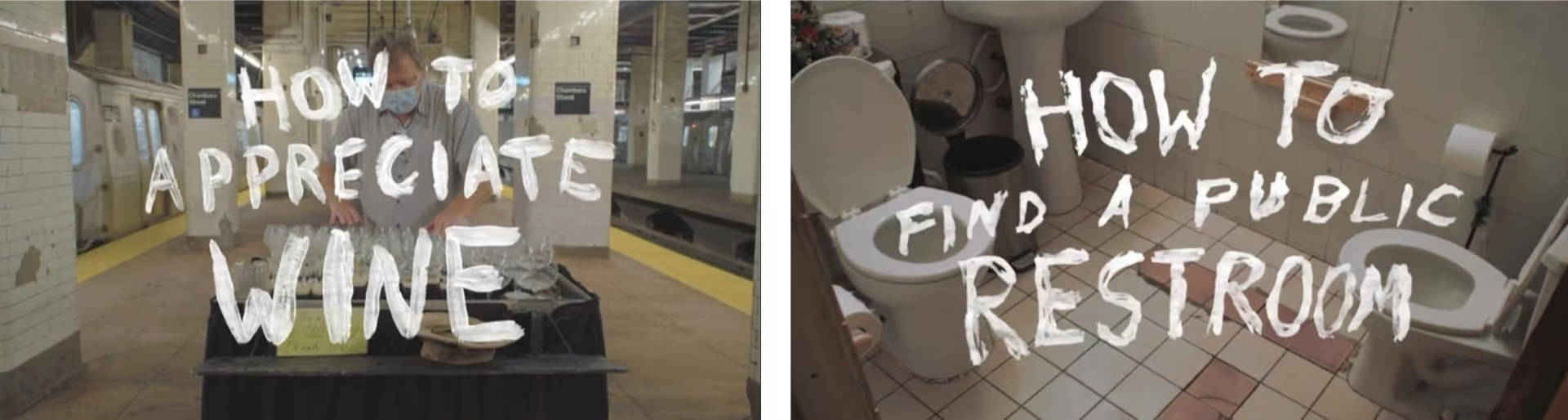
In each roughly 30-minute episode, documentary filmmakerJohn Wilson sets out on an exploratory journey through New York City, triggered by a specific question. He allows himself to be diverted by new phenomena that pop up along the way. If you want to know how one gets from watching a football game to the niche world of vacuum cleaner collectors, don't miss it.
It’s curious, clever, funny, sensitive, open, and - thanks to its constant self-reflection -very contemporary. Beyond being incredibly entertaining, it teaches us a lot about American (and universal human) culture.
As a researcher, I find it deeply inspiring; it reveals so much about ethnography and the qualitative approach.

Key takeaways (not just for qual researchers)
THE VALUE OF OBSERVATION
John Wilson doesn't work based on hypotheses; he simply watches. In research, we often don't know at the start what will be important or relevant. Frequently, it’s through the observation of trifles - using inductive logic - that we reach significant insights. Patterns and structures emerge from a multitude of small things. Never neglect the "little things."
THE GUIDE IS A GUIDE, NOT THE HOLY SCRIPTURE
An interview guide is key - it’s where we theme our most important questions. However, if you hear something unexpected during a conversation that adds value to the topic, follow it. You are allowed to trust your instincts.
BE CURIOUS INSTEAD OF JUDGMENTAL
Despite being a self-proclaimed anxious person, John Wilson isn't afraid to enter strange or awkward situations. Thanks to his openness, his interviewees willingly share their deepest feelings. He doesn't judge, mock, or use irony or superiority; he is simply curious, attentive, and asks questions.

THE ADDED VALUE OF IMAGERY
This is a show you have to watch with your full attention. For Wilson, even the B-roll footage has meaning - it’s never just illustration. Similarly, in ethnographic research, stock photos should be avoided; "decorating" adds no value. And if you see something interesting while out and about (regardless of research), take a photo! It will be worth its weight in gold.
CULTURAL SPECIFICITY
While the series features many universal human emotions and behaviors, the unique flavor comes from local cultural specificities - like investigating the scaffolding covering New York or the very particular local parking culture. This is crucial in ethnographic and cultural research: you have to step back to see phenomena that are locally obvious but strange to an outsider.
SELF-REFLECTION
A fundamental trait of ethnography is the observer's paradox: by being present, we alter the context. John Wilson minimizes this not only through his openness but by constantly reflecting on his own uncertainty and awkwardness. He leaves in the uncomfortable silences and the failed conversations. As a researcher, there is value in observing how we feel in a given situation (even if we don't voice it).
TIME AND PATIENCE
For the first season, the crew recorded up to 40 hours of raw footage per week over two years. Those thousands of hours were eventually edited down to roughly 3 hours of airtime. Of course, in qualitative research, there isn't time for data collection on that scale, but the abundance and number of sources - whether participants or the breadth of desk research - are vital. This provides validity, depth, and the opportunity for truly significant findings to stand out from the noise.
Summary:
How To with John Wilson (and the documentary genre in general) teaches us much about the approaches and methods that can be used to process a topic. What makes this series outstanding is its openness: it takes nothing as trivial, avoids immediate interpretation, and isn't afraid to deviate from the script. It’s a powerful lesson in how honest curiosity and a non-judgmental presence often open up subjects more effectively than even the best questions.
Tip
A tip for your daily life (and essential for researchers): Whenever you hear something you find strange, or that triggers a gut reaction of resistance or judgment, instead of making a statement, just ask: Why? Whydo you think that? What do you like about it? Why is it important to you? You don't have to agree with others, but we can learn a lot by understanding perspectives different from our own.